There is no single “best” switch—only best for a specific feel, sound, and use case. Instead of chasing whatever linear or tactile is trending this month, it’s more useful to think in switch archetypes.
Stop Asking “What’s the Best Switch?”
An archetype is a combination of:
- Actuation type (linear, tactile, clicky)
- Sound character (thock, clack, pop, muted, marbly)
- Travel and weight (light, medium, heavy)
- Material and housing style (POM, nylon, long‑pole, etc.)
Once you know which archetype fits you, you can build boards more deliberately: a crisp low‑profile work board, a deep “thock cannon” gaming setup, or a near‑silent late‑night writing deck.
This guide breaks down the main switch archetypes, ties them to real-world examples, and shows how keycap profiles, materials, and basic mods push each archetype into its best version.
Archetype 1: Classic Long-Travel Linear “Thock” Build
Use case: Daily driver, gaming, long sessions.
Goal: Soft, cushioned bottom-out with a deep, satisfying sound.
The Feel
- Full 4.0 mm travel or close to it.
- Medium weight springs (around 58–63.5 g bottom-out).
- Smooth, non‑jarring bottom-out; more “landing” than “slap.”
The Sound
- Lower‑pitched, full “thock,” especially in alpha keys.
- Minimal spring ping, no rattly top‑housing resonance.
Switch Examples (2026‑Relevant)
- Gateron Oil King – Gold standard for this archetype: smooth, deep, consistent.
- Durock POM Linear – POM housings contribute to that marbly low frequency.
- JWK Alpaca V2 / modern JWK clones – Classic smooth long‑travel linear that takes well to lube.
Best Keycaps & Profiles for This Archetype
- Thick PBT (Cherry profile) like PBTfans or NicePBT:
- Emphasizes body and warmth.
- Reduces unnecessary high‑end clack.
- Cherry-profile ABS (GMK) if you want a slightly brighter, but still deep sound.
SA and MT3 can work, but they can introduce hollowness if your case and plate aren’t well damped.
Minimal Mods to Unlock It
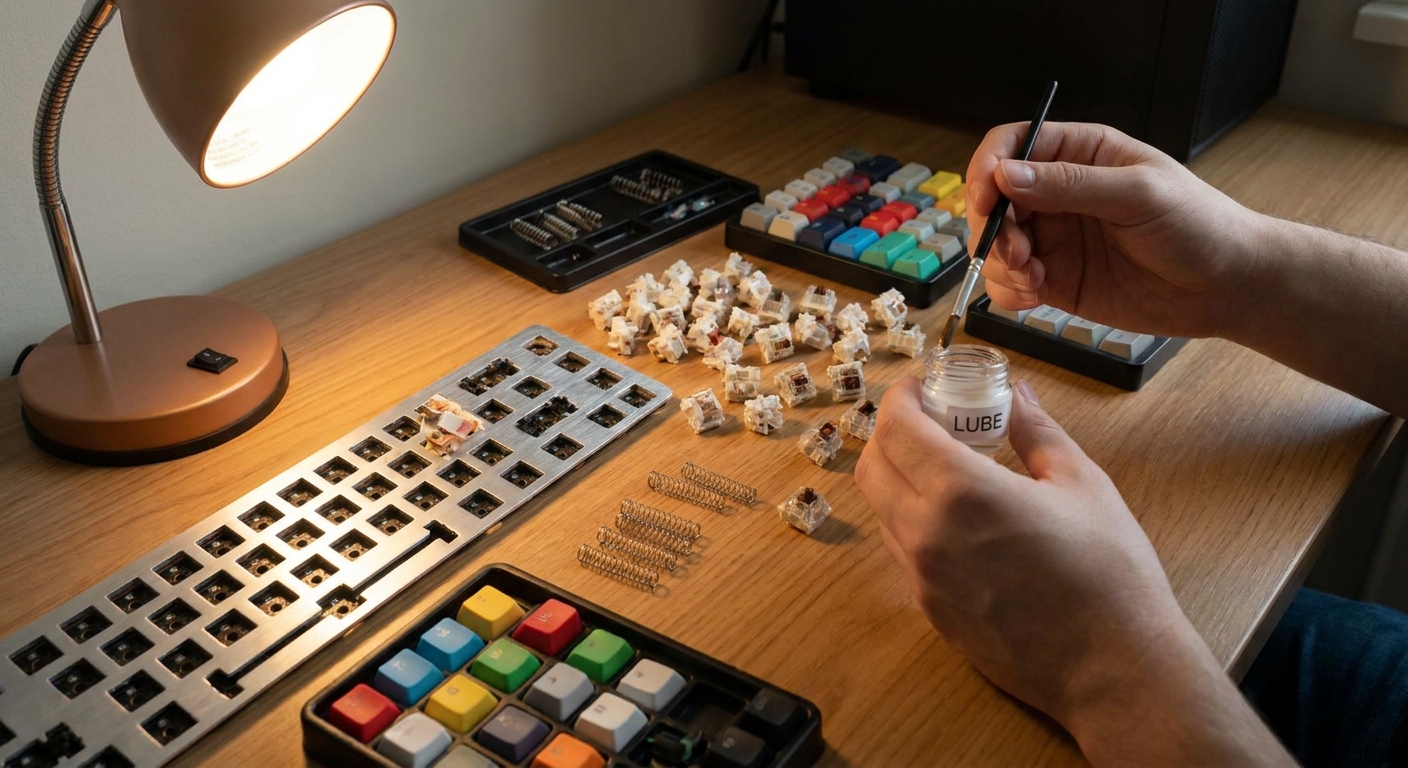
- Lube: 205g0 on stems + rails, springs treated with 105 oil.
- Films: Use TX/Deskeys if the housing is obviously loose; Oil Kings often benefit from a film for ultra‑consistent sound.
- Case Damping: One layer of PE or PORON under the PCB, not stuffed; you want controlled resonance, not a muted board.
Archetype 2: Sharp, Snappy Tactiles for Fast Typing
Use case: Coding, writing, work; when you want feedback but not noise chaos.
Goal: Defined bump, quick reset, precise feel.
The Feel
- Pronounced bump before actuation.
- Medium‑light to medium weight, with a snappy return.
- Ideally no pre‑bump mush.
The Sound
- "Pop" or "tap" more than pure thock.
- A bit of high‑frequency edge is fine as long as it’s not harsh or metallic.
Switch Examples
- Gazzew Boba U4T – Heavy but incredibly satisfying; the archetypal thocky tactile.
- Durock T1 / Taro / Shrimp‑type tactiles – Raindrop tactility, well‑known and easy to tune.
- Keychron K Pro Brown / Gateron Baby Kangaroo – Modern, refined tactiles for mainstream builds.
Best Keycaps & Profiles
- Cherry‑profile ABS (GMK, Milkyway):
- Emphasizes the "pop" and makes tactility feel precise.
- Great for people who like to hear each press.
- OEM PBT if you want to tame the highs a little without losing character.
Smart Modding Choices
- Very light lube (Tribosys 3204) on:
- Stem sides and housing rails.
- Little to none on the tactile legs until you test—too much turns them into quasi‑linears.
- Films are optional; many modern tactiles are already tight. Test a few with and without.
Tip: If your tactiles feel fatiguing over long sessions, spring swap to a slightly lighter long spring (e.g., 55–58 g) to maintain bump character but reduce bottom-out stress.
Archetype 3: Ultra-Silent, High-Control Walk-On-Clouds Board
Use case: Shared offices, late‑night typing, stream setups where mic discipline matters.
Goal: Maximum acoustic stealth without mush.
The Feel
- Short, cushioned bottom-out.
- Light–medium weight to avoid finger fatigue.
- Tactile or linear depending on preference; tactiles can help you type lighter.
The Sound
- Dull “thud” or nearly no audible bottom-out.
- No spring ping, no leaf tick, minimal case resonance.
Switch Examples
- Gazzew Boba U4 (silent tactile) – The benchmark: soft, controlled, tunable.
- Silent Alpaca / Durock Silent Linears – For a linear variant of this archetype.
- Cherry MX Silent Red / Pink – Easy to source, respond very well to tuning.
Keycaps & Profiles
- Thick PBT (Cherry or OEM):
- Slightly more muted top‑end, which stacks nicely with silent switches.
- Helps you avoid the “silent switch, loud keycap” mismatch.
- Avoid very thin ABS; they can betray the silence with high‑pitched clack.
Mods That Matter Here
- Proper lube:
- Dampening pads on stems (where present) should not be over‑lubed; you want them to compress, not drag.
- Lube rails and springs thoroughly to kill any residual noise.
- Case and Plate Damping:
- PORON/foam between plate and PCB and under PCB.
- Gasket mount or soft tray mount to avoid harsh mechanical resonance.
Extra tip: Try a polycarbonate plate. It softens both sound and feel and pairs exceptionally well with silent switches.
Archetype 4: Low-Profile, Speed-Oriented “Clicky-Adjacent” Setups
Use case: Gaming or input where you want fast actuation and high clarity without full classic clicky chaos.
Goal: Tight, short travel, immediate response.
The Feel
- Shorter travel (3.2–3.5 mm) or long‑pole linears.
- Light–medium weights with fast return.
- Less movement = faster repeat input.
The Sound
- Crisp, focused, often mid‑to‑high pitched.
- More “clack” than “thock.”
Switch Examples
- Long-pole linears like various HMX or JWK customs – shorter effective travel, distinct bottom-out.
- Kailh Choc / low-profile designs – True low-profile builds.
- Tactile long‑poles for people who want feedback + speed.
Keycaps & Profiles
- Low-profile caps for real low‑profile switches.
- Cherry / KAT / KAM on long‑pole linears:
- Cherry: crisp and controlled.
- KAT/KAM: can add a bit more chamber resonance.
Mod Priorities
- Very controlled lube:
- Too much can kill the “snap” long‑poles are known for.
- Stiffer plates (aluminum, steel) emphasize the crisp character and speed.
Be honest with yourself: this archetype can be fatiguing if you type a lot of prose. It shines in high‑APM gaming, not 8‑hour writing marathons.
Archetype 5: Classic Clicky Nostalgia (With Modern Restraint)
Use case: Solo office, nostalgia builds, boards where you want the sound to be a feature.
Goal: Satisfying click without sounding like a toy.
The Feel
- Distinct top‑side bump or click jacket mechanism.
- Usually lighter weight to encourage crisp engagement.
The Sound
- Audible “click,” ideally non‑rattly and well‑timed with actuation.
- Seek a mid‑pitch click; ultra‑high click can sound cheap, low click can feel sluggish.
Switch Examples
- Kailh BOX White / Pale Blue – Cleaner click than old MX Blues.
- Kailh BOX Jade / Navy – Thicc click; not for shared spaces.
- TTC Bluish White / modern refined clickies where available.
Keycaps & Profiles
- Cherry ABS strongly emphasizes click definition and nostalgia.
- Thick PBT can blunt the harshness a bit if your desk neighbors are slowly losing their minds.
Real Talk Modding
- Clickies aren’t typically lubed on the click jacket/leaf; you can lube springs and sliders lightly to remove scratch.
- Plate, case, and keycap choices will make or break perceived quality—cheap caps make expensive clickies sound bad.
Matching Archetypes to Your Actual Life
Instead of buying every “top switch of the month,” walk through these questions:
When and where do you type?
- Shared space → Silent / soft archetypes. - Private room → Go wild with thock or click.
How long do you type at a stretch?
- Long coding/writing → Medium weight, smooth or gentle tactiles. - Short gaming bursts → You can go heavier or snappier.
What do your fingers naturally like?
- If you bottom-out hard on any board you touch → consider cushioned long‑travel archetypes. - If you float and tap lightly → tactiles or silent tactiles shine.
Once you’ve answered those, pick one primary archetype and build around it.
Concrete Builds: Archetype Recipes You Can Actually Copy
Recipe A: Deep-Desk Thock Linear
- Switch: Gateron Oil King, lightly lubed, filmed.
- Board: Gasket-mounted 65% or TKL, aluminum case, polycarbonate plate.
- Keycaps: Thick PBT Cherry profile.
- Mods: Light case foam, tape mod on PCB if you want more boom.
Result: Cushioned, deep, satisfying thock that doesn’t feel sluggish.
Recipe B: Controlled Tactile Typing Machine
- Switch: Durock T1 or Gazzew U4T, lightly lubed on rails, minimal leg lube.
- Board: Metal or dense plastic 75% with FR4 plate.
- Keycaps: Cherry‑profile ABS (GMK style) for clarity.
- Mods: PORON between plate and PCB, tuned stabilizers.
Result: Fast, accurate, slightly poppy tactility that rewards touch typing.
Recipe C: Midnight Writer Silent Setup
- Switch: Gazzew Boba U4, thoroughly but carefully lubed.
- Board: Gasket or top‑mount 60–75% with polycarbonate or POM plate.
- Keycaps: Thick PBT Cherry profile.
- Mods: Plate foam, PCB foam, light case fill (not packed).
Result: Feels luxurious under the fingers, sounds like typing into a pillow.
Keycap Nuances That People Skip (But You Shouldn’t)
When dialing in any archetype:
- Uniform vs sculpted profiles:
- KAM/KAT uniform profiles give an even sound signature across rows.
- Sculpted profiles (Cherry, OEM) introduce slight row‑to‑row variations.
- Legends and surface texture:
- Smooth ABS feels faster; textured PBT can encourage more controlled strokes.
- Rougher PBT slightly accentuates the sound of key release.
Changing keycaps can shift your board from Archetype 1.5 to Archetype 1 or 2. Treat caps as a primary tuning tool, not an afterthought.
How to Experiment Without Going Broke
- Buy in small packs first: 10–20 switches from each archetype instead of 90+ blind buys.
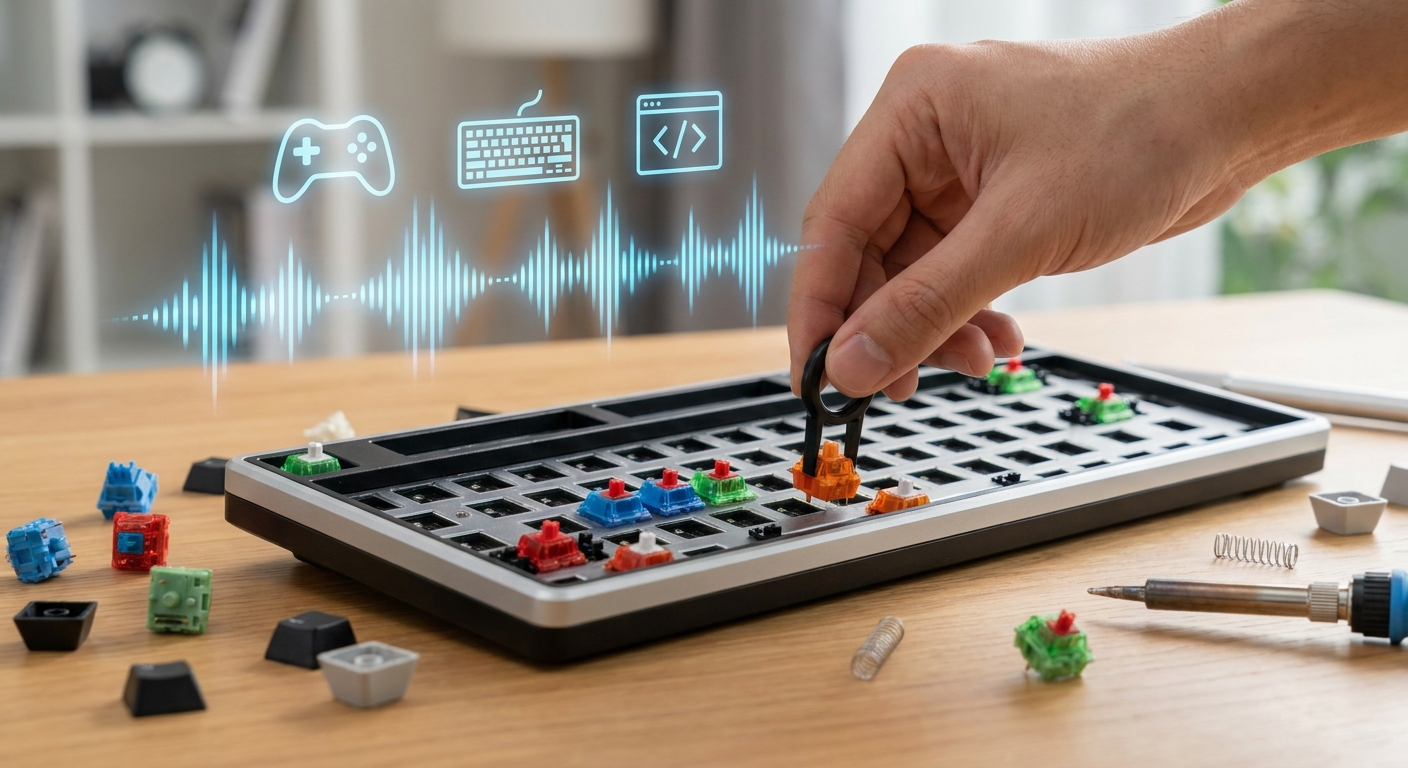
- Use a hot-swap tester or board: Makes comparisons painless.
Keep a spreadsheet or notes:
- Column for feel (1–10), sound (pitch/texture), fatigue, and comments. - You’ll start seeing patterns in what you actually like. 4. Change one thing at a time: If you swap both plate and caps, you won’t know what caused the improvement.
Final Thoughts: Don’t Chase Hype, Chase Archetypes
The mechanical keyboard hobby moves fast, but the underlying archetypes barely change. Nearly every new switch can be slotted into one of these patterns once you listen critically.
Know what you want from feel and sound before you buy. Use a couple of carefully tuned boards as your reference points. And when new switches drop, don’t ask “Is this S‑tier?”—ask “Which archetype is this, and does it solve a problem my current boards don’t?”
That’s how you build a collection you actually use, not a drawer full of half‑loved switches.