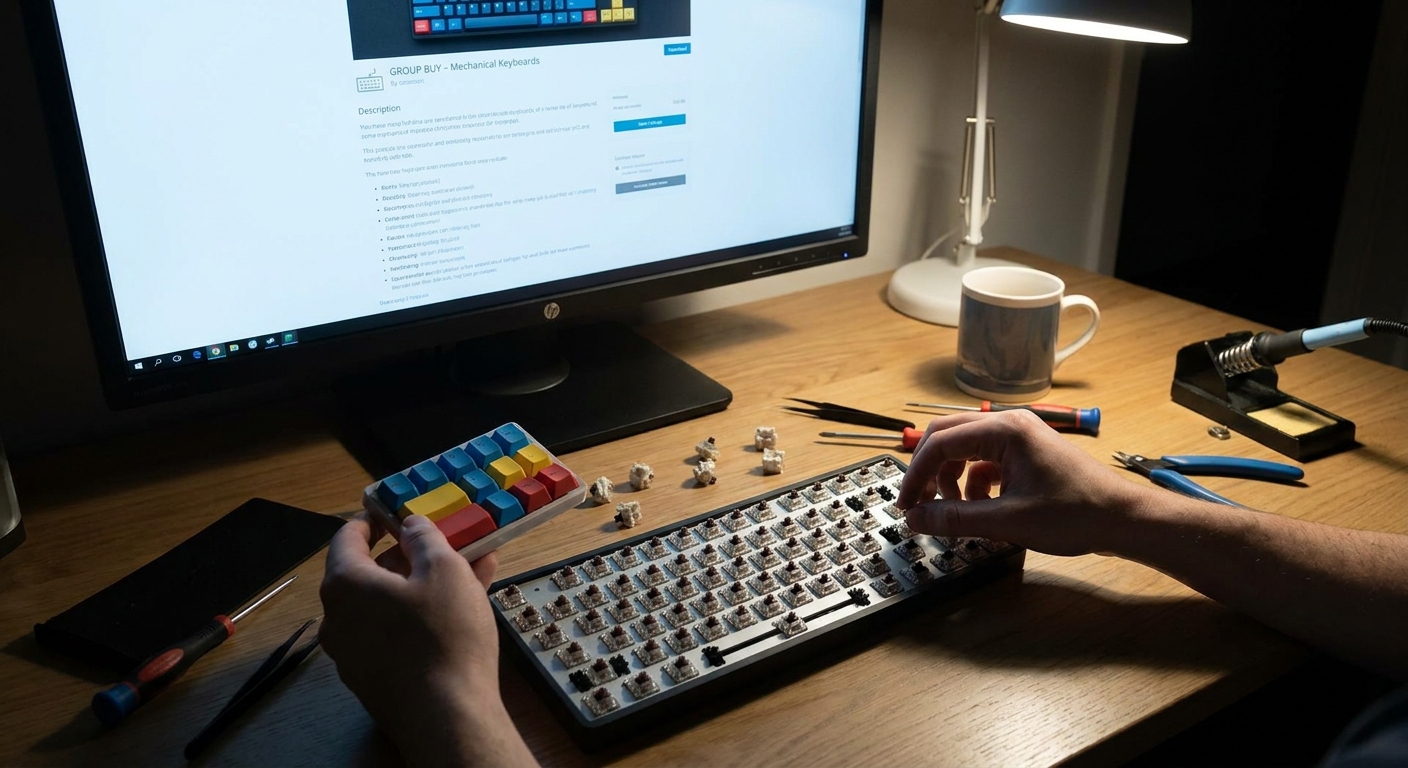
If you hang out in any mechanical keyboard Discord, Reddit thread, or vendor newsletter list long enough, you’ll notice a repeating rhythm: Interest Check → Group Buy → Photos → FOMO → Round 2.
Why Group Buys Are the Beating Heart of the Keyboard Hobby
Group buys are how most of the niche, boutique keyboards, switches, and keycaps you see on Instagram and Geekhack actually become real. They’re preorders with a twist: your money is funding the production run. That means more risk and more waiting—but also more control and more variety than a normal retail market could ever support.
This guide walks through the full lifecycle of a group buy from an enthusiast’s perspective: how to evaluate projects, what to expect from switches and caps, how to plan your build and mods around a 12-month wait, and what gear is genuinely worth your money.
Step 1: Reading an Interest Check Like a Veteran
Before a designer launches a group buy, they usually post an Interest Check (IC). Think of this as the pre‑preorder where feedback actually matters.
Key things to scrutinize:
1. Design & Layout
- Layout support: 60%, 65%, 75%, TKL, full-size, Alice/ergo? Check if it supports your essentials: split backspace, ISO, 7u bottom row, F13, etc.
- Plate options: Aluminum (stiffer, clackier), brass (heavy, bright), polycarbonate (PC, soft and thocky), POM (creamy and muted), FR4 (balanced and slightly snappy).
If you know you’re a long-pole linear + tape mod + deskmat enjoyer, you probably want a softer plate (PC, POM, FR4) plus gasket or top‑mount.
2. Mounting Style & Sound Profile
Mounting style is your first big hint at how the board will feel and sound:
- Tray mount: Stiff, old-school, cheap. More “clack”, less flex.
- Top mount: Screws through the plate to the top case. Tight, consistent, mildly resonant. Good for tactiles.
- Gasket mount: Plate/PCB sandwiched on foam or rubber. Softer, more flex, typically deeper and more muted.
- Burger/isolated top mount: Screws with o-rings. Somewhere between classical top mount and gasket, with a nice controlled bounce.
If the IC includes sound tests, listen for:
- Clack: Higher-pitched, sharp; more pronounced on aluminum plates and thin cases.
- Thock: Lower, rounder; usually associated with PC/POM plates, foam, and long-pole linears.
- Marble/ceramic: That glassy, ringing quality you hear on some thin aluminum cases with brass plates.
3. Vendor & Manufacturing Credibility
Look for:
- Vendor has run previous GBs and actually delivered.
- Manufacturer is named (e.g., JLC, Keychron OEM, known CNC house, or established cap manufacturer).
- Timelines that aren’t obviously fantasy (6–12 months is typical for keyboards and keysets, 3–6 for switches).
If the IC dodges details on vendors and manufacturers, mentally add risk.
Step 2: Picking the Right Switches for Your GB Build
When you join a keyboard or keycap group buy, you should already be thinking about switches. The synergy matters.
Linears: For the Ultra-Clean Thock
Linears shine in gasket mount + soft plate builds.
What to look for in linear GB switches:
- Long-pole stems (e.g., JWICK, Gateron North Pole style): Louder, snappier bottom-out, pronounced “tok”.
- Housing material:
- POM top + Nylon bottom: Creamy, mid-deep sound.
- Polycarbonate top + Nylon bottom: Brighter top notes with some depth.
- Factory lube quality: Some GB linears come lightly but consistently lubed—often good enough that you can skip hand-lubing if you’re not hyper-picky.
Example sound target: If you’re chasing the "marbled thock" meta, look for a polycarbonate or POM plate, gasket mount, and mid-weight linears (~60–63.5 g) with long poles.
Tactiles: For Satisfying Bumps and Richer Tone
Tactiles pair well with top mount or burger mount to keep the bump feeling crisp.
What to look for in tactile GB switches:
- Bump shape:
- Early, rounded bump (like Boba U4T style) = meatier feel, more bass in sound.
- Sharp, mid-travel bump = more pronounced tactility without getting heavy.
- Top-out sound: Some tactiles sound dry and papery, others have a sharp “tack.” Listen to multiple sound demos; tactiles are more sensitive to case acoustics than linears.
Silent & Specialty Switches
Silent switches in GBs are often tuned with softer housings and silicone dampeners. These will emphasize:
- Deep, subdued thocks in gasket boards.
- Slightly mushy feel if you use too much plate foam.
If you work in an office or share a room, joining a silent switch GB plus a flexible gasket board is a practical combination.
Step 3: Matching Keycaps to the Board (Profile, Material, and Sound)
Keycap group buys are where many people start. Profiles and materials shape both hand feel and sound.
Profile Deep-Dive
- Cherry profile (e.g., GMK, CRP): Sculpted, low-ish profile, beloved for ergonomics and aesthetics.
- Sound: Thocky and controlled on most builds, with short travel.
- SA profile: Tall, spherical tops.
- Sound: Boomy and resonant. On a long-pole linear build, this can give you a deep “bong” on bottom-out.
- MT3 / HiPro-style: Deep-dished tops, old-school vibes.
- Sound: Similar to SA but a bit more focused; lots of low-frequency body.
- KAT/KAM: Modern, uniform-ish profiles with thick PBT.
- Sound: Dense and muted, especially good on boards that skew bright.
Material & Manufacturing
- ABS Double-shot (e.g., GMK):
- Starts slightly higher-pitched, then deepens as it shines and ages.
- Legends are ultra-crisp; classic for retro and custom colorways.
- PBT Dye-sub:
- Slightly rougher texture, more resistant to shine.
- Sound is more muted and sandy, great if your board is already clacky.
- PBT Double-shot:
- Very resilient legends, slightly deeper sound than ABS.
Pairing tips:
- Bright board (aluminum case + brass plate + clacky linears) → Thick PBT or MT3 to tame harshness.
- Soft, deep board (POM plate + gasket + foam) → Cherry ABS if you want a clean, articulated thock.
Step 4: Planning Mods Before the Kit Arrives
Because group buy waits are long, this is your chance to prep all the supporting gear and mods.
Essential Mods to Plan For
Switch Lubing & Filming
- Linears: 205g0 on stems/housings, light oil on springs (105 or 106). Aim for glide without stickiness. - Tactiles: Thinner lube (e.g., 3204) and avoid lubing the bump if you like a sharper feel. - Films: Polycarbonate films for loose housings (e.g., some Gateron variants) to tighten sound.
Stabilizer Tuning
- Clip and lube your stabs with dielectric grease (wire-to-housing) and thick lube on housings. - Holee mod or band-aid mod on the PCB to reduce rattle. - For long-pole switches, pay special attention: any rattle will be extra obvious.
Case & Plate Damping
- PE foam between plate and PCB can emphasize pop and thock, especially with linears. - Poron plate foam softens sharpness and stabilizes the sound across the board. - Case foam fills hollow resonance; use sparingly if you want natural reverb.
If your GB kit includes foam, read build logs and watch early builds before deciding to use all of it—you can over-damp and kill the character.
Step 5: Honest Gear Recommendations for GB-Centric Builders
Switch Essentials
- Budget Linears for Any GB Board: JWK/JWICK linears, Gateron Oil Kings, or a well-reviewed long-pole linear from a reputable manufacturer. Great baseline and easy to tune.
- Workhorse Tactiles: Boba U4T, Durock Medium Tactiles, or a similar strong-bump switch. Ideal if you want a characterful build with less reliance on foam.
Lubes & Tools
- 205g0: The gold standard for linears and stabilizer housings.
- 3204: For tactiles and folks who dislike overly slow-feeling switches.
- Krytox 105/106 or GPL 105 oil: For springs.
- Decent switch opener, fine-tipped brushes, and a switch puller that won’t maul your housings.
Keycaps to Pair with Future GB Boards
- A thick Cherry PBT set in a neutral color (white/black/grey) so you can build and enjoy boards while you wait for themed sets.
- One ABS Cherry profile set from a reputable maker for that classic clack-to-thock evolution.
Step 6: Managing Risk, FOMO, and Expectations
Because group buys are not the same as retail, keep in mind:
- Timelines slip. PCBs fail QC, factories move, shipping slows. Mentally add 3–6 months.
- Prototypes matter. If the IC/GB shows multiple prototypes, that’s a good sign—they’re iterating instead of rushing.
- Refund policies vary. Some vendors treat GBs as final-sale; others are more flexible pre-production. Always read the fine print.
One sanity rule: Never join more group buys than you can comfortably forget about. If the money is going to stress you out, skip or wait for extras.
Step 7: The First Build When It Finally Arrives
When your box finally lands:
- Inspect everything: Finish, weight, internal machining, PCB and plate alignment.
- Dry fit: Plate + PCB + a few switches, test in VIA/QMK before full assembly.
- Tune stabs first: Get these right before you solder or fully seat switches.
Layer mods gradually:
- Start with no foam. - Add plate foam if you want more uniformity. - Add case foam last if you still find it too hollow.
Record a few sound tests at each stage. It’s amazing how much you can learn about your preferences from a single GB build.
Final Thoughts: Group Buys as a Long-Game Hobby
Group buys are slow by design. They turn the hobby into a long conversation between designers, vendors, and the community. When you dig into the details—mounting styles, plate choices, switch synergy, keycap profiles—you stop chasing the latest render and start building keyboards that sound and feel exactly the way you want.
Treat each group buy as a project. Plan your switches, your keycaps, your mods, and your budget. The end result is more than a keyboard on your desk—it’s the culmination of months of anticipation, tinkering, and shared community knowledge.
And when you hit that first spacebar on a fully dialed‑in GB board, with tuned linears and a keycap set you waited a year for, you’ll know exactly why we keep coming back.