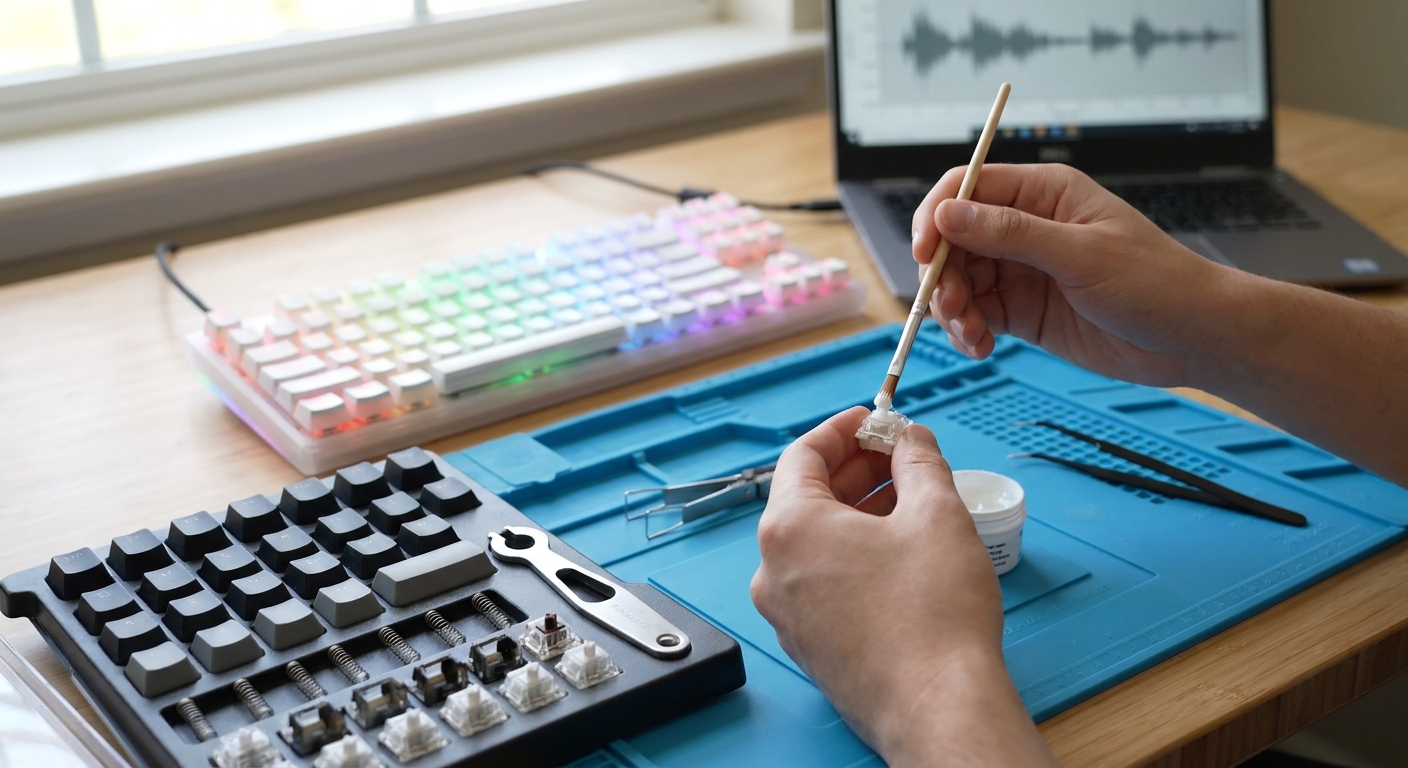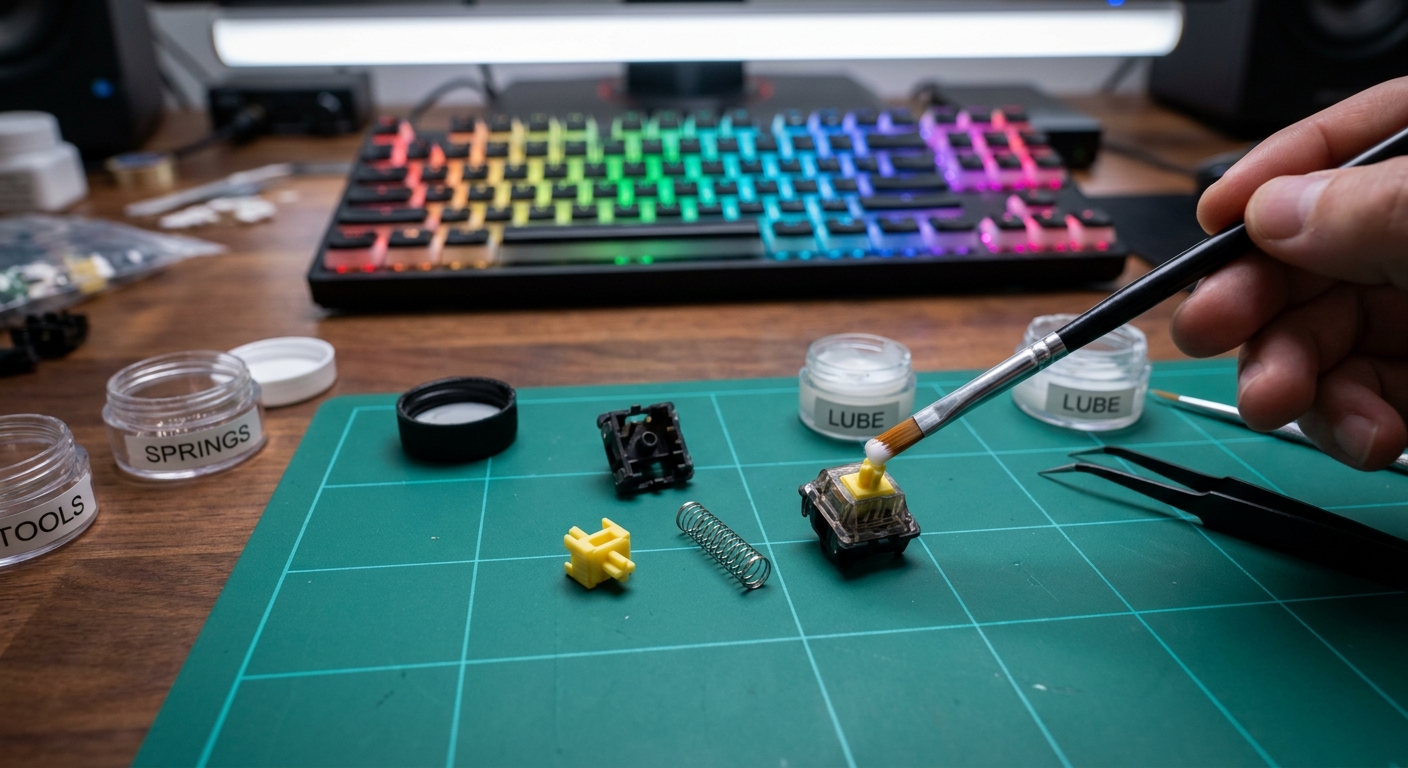
If you hang around keyboard Discords long enough, you’ll notice a pattern: people chasing a better sound and feel by buying new boards… when what they really need is a syringe of lube and an afternoon.
Why Mods & Lubing Matter More Than Your Next Board
Stock switches, stabs, and keycaps are the starting point, not the final form. Mods and lubing are where the keyboard actually becomes yours: the sound signature tightens up, scratch turns to glide, and the rattle that once haunted your spacebar disappears.
This guide walks you through the core mods and lubing techniques that consistently transform "meh" builds into keepers.
Step 1: Understand Your Endgame Feel & Sound
Before you touch a single switch, decide what you're chasing:
- Sound profile
- Deep & muted: Think gasket-mount boards, PBT caps, filmed linears, generous case foam. "Thock" more than "clack".
- Crisp & poppy: Plate-mount energy, thin caps, snappy tactiles, minimal foam. You want volume and definition.
- Balanced: Slightly damped but still with top-end presence.
- Feel profile
- Cloud-like linear: Soft springs (55–60g), heavy switch lube, slow return.
- Snappy linear: Medium springs (63.5–67g), light lube, fast return.
- Rounded tactile: Pre-travel bump with a smooth, lubricated leaf to avoid harshness.
- Sharp tactile: Minimal lube on the legs to preserve the bite.
Write down your preferences; it will guide every decision: lube type, thickness, spring weight, whether to film, and how aggressive to be with mods.
Step 2: Switch Lubing – The Core Skill
What You Need
- Brush: Size 00 or 000 synthetic. Avoid huge craft brushes.
- Lubricants:
- Krytox 205g0: The community default for linears; medium-thick, buttery. Also good for housings on tactiles.
- Tribosys 3203/3204: Thinner; great for tactiles where you want to preserve the bump.
- 105 or GPL 105 oil: For springs and sometimes for stems if you prefer oil-only lubing.
- Switch opener: Tailored to your switch type (Cherry-style, Kailh-style).
- Tray or mat: Keep parts organized. You will lose a spring if you don’t.
Lubing Linears: From Sandpaper to Silk
Target switches: e.g., Gateron Milky Yellows, HMX, JWICK, Oil Kings, etc.
Open the switch
- Gently press top housing into the opener, pull apart. Keep direction consistent for reassembly.
Lube bottom housing
- Dip brush in 205g0, then wipe most of it off on the jar edge. You want a sheen, not a blob. - Hit: slider rails, bottom floor where stem feet land, sides of the center pole. Avoid the leaf.
Lube the spring
- Quick method: Toss springs in a bag with 1–2 drops of 105, shake, then dry on a towel. - Precision method: Brush both ends lightly. Eliminates ping reliably.
Lube the stem
- Apply a thin coat of 205g0 to the sides and front/back faces. - Hit the legs and the cylindrical pole very lightly. - Avoid overloading the bottom of the stem pole to reduce risk of mushy bottom-out.
(Optional) Film the switch
- If your switch has housing wobble (older Gats, some JWKs), add PC or HTV films. 0.125–0.15 mm is typical. - Place film on the bottom housing, then close with the top snugly.
Result: A properly lubed linear will:
- Sound: Lower-pitched, fuller, and more focused. Less plastic tick, more solid "tok" or "thock".
- Feel: Glass-smooth travel with stable top housings and no spring crunch.
Lubing Tactiles: Smoothing Without Killing the Bump
Target switches: Holy Pandas, Boba U4T, Boba U4, T1s, etc.
Use a thinner lube
- 3203/3204 or even a mix (3204 on housing, 205 light on spring) works well.
Avoid the legs if you want a strong bump
- Lube the housing rails and stem sides like a linear. - For strong tactiles, only lightly brush the legs if they feel scratchy. For U4T/Holy Panda style tactiles, do not gob 205g0 on the legs unless you intentionally want a softer bump.
Check leaf noise
- If you hear leaf "zing" or tick, you can very carefully brush a micro-amount of thin lube near the leaf, but avoid drowning it.
Result:
- Sound: Cleaner tap with less leaf/tick noise, still with a distinct "pop" from the bump.
- Feel: Bump is preserved but the pre- and post-bump travel feel more controlled and less scratchy.
Step 3: Stabilizer Mods – Killing Rattle for Good
Even a perfectly lubed switch can be ruined by a rattly spacebar.
Types of Stabs
- Plate-mount: Cheap, common in prebuilts. Harder to silence fully.
- PCB-mount clip-ins: e.g., Cherry. Better, but can wobble.
- Screw-in: e.g., Durock, TX, Owlstabs. The current standard.
The Core Mods
Holee mod (on PCB-mount/screw-in)
- Wrap a tiny strip of band-aid/micropore tape around the wire where it enters the stem. - Removes wire rattle and softens impact. - Combine with lube; don’t use instead of it.
Band-aid mod
- On the PCB under the stab feet, add band-aid or cloth tape. - Softens bottom-out and reduces ticking.
Lubing stabs
- Use a thicker lube/grease (e.g., XHT-BDZ sparingly, dielectric grease, 205g0). - Lube inside the housing where the stem slides and the wire sits. - For the wire: a decently heavy coat where it sits in the housing, but don’t cake the entire length.
Target sound:
- Spacebar: Deep, solid "thunk" without metal tick.
- Enter/Shift/Backspace: Slightly higher pitched but still solid, no after-rattle.
Step 4: Keycaps – Profile and Plastic Shape Your Sound
Keycap profile & material are often underestimated mods. The same lubed switches can sound and feel wildly different with another set of caps.
Materials
- PBT
- Sound: Slightly more muted and textured, often a deeper note.
- Feel: Grittier surface, resists shine.
- Great for: Deep, "thock" builds.
- ABS (especially thick, GMK-style)
- Sound: Brighter, more resonant "clack" or "pop".
- Feel: Smooth, becomes shinier with wear.
- Great for: Lively, signature "clack" builds.
Profiles & Their Influence
- Cherry: Shorter than OEM, sculpted rows. Deep(ish), focused sound, comfy for long sessions.
- SA / MT3: Tall and sculpted; sound becomes boomy and resonant. Great for maximal thock if your build is already deep.
- DSA / XDA: Uniform, relatively low; sound is more consistent across the board but often a bit more muted.
If you want to tune a build:
- Build sounds thin and tinny?
- Build sounds too boomy and muddy?
→ Move from ABS OEM to thick PBT or SA/MT3.
→ Try Cherry ABS or thinner caps to reclaim some crispness.
Step 5: Case & Plate Mods – The Final Layer of Tuning
Once switches and stabs are dialed, the case and plate are where you refine resonance.
Easy, High-Impact Mods
- Case foam (Poron / EVA): Fills the empty space, reducing echo and hollow ring.
- Plate foam: Dampens plate reverb, can deepen the sound, sometimes at the cost of crispness.
- Tape mod (Tempest mod): Painter’s tape on the back of the PCB. Adds a satisfying “boing” to some builds and can deepen overall pitch.
Use these sparingly: over-dampening leads to a dead, unresponsive sound. Many hobbyists end up removing foam after they learn to lube and film properly.
Honest Gear Recommendations (Based on Use Case)
These are not sponsorship picks, just parts that consistently perform well:
For Smooth, Deep Linears
- Switches: Gateron Oil Kings, HMX series, JWICK linears, KTT Hyacinth V2.
- Lube: 205g0 for stems/housings, 105 oil for springs.
- Keycaps: Thick PBT Cherry or MT3 for more depth.
For Tactile Enjoyers
- Switches: Boba U4T (loud & thocky), Boba U4 (silent), TTC Bluish Whites, Durock T1 for budget.
- Lube: 3204 on housings, minimal on legs if at all.
- Keycaps: ABS Cherry for satisfying pop, PBT for more muted tactility.
For Stabs That Actually Behave
- Stabilizers: Durock V2 screw-ins, TX stabs, Owlstabs.
- Lube: Dielectric grease or XHT-BDZ (use sparingly) on wires; 205g0 on housings.
A Practical Walkthrough: Transforming a Budget Board
Let’s apply all this in a compact example.
Starting point: Hot-swap 75% budget board, north-facing RGB, stock plate-mount stabs, stock linears, ABS OEM keycaps. Sounds: thin, rattly, inconsistent.
Goal: Deep, clean, semi-muted daily driver with a solid spacebar.
Steps:
- Disassemble the board – Take photos as you go to remember stab locations.
- Replace stabs with screw-ins – Durock V2, holee mod for spacebar, dielectric grease on wires and housings.
- Lube linears (e.g., JWICK or Gateron Milky Yellows) – 205g0 + filmed if loose.
- Optional foam & tape – One layer of case foam; test with and without plate foam. Add 1–2 layers of tape mod if you want extra bounce and depth.
- Swap keycaps – Move to a thick PBT Cherry profile set.
Result:
- Sound: Deeper, more solid, no rattle; keys produce a cohesive "thock" cluster instead of disconnected ticks.
- Feel: Smooth travel, consistent bottom-out, stable modifiers, quiet return.
Closing Thoughts: Mods First, New Boards Later
Modding and lubing are the difference between a board that’s just "expensive" and a board that feels finished. Before chasing the next high-end case or exotic mounting style, learn to:
- Lube linears without mush.
- Smooth tactiles without killing their soul.
- Silence stabs until they disappear.
- Tune sound with keycaps and minimal, intentional foam.
Those skills follow you from build to build and turn even budget setups into endgame contenders.
If you want a follow-up, we can dive into advanced mods: spring swapping, stem/slider Franken-switches, and plate material comparisons.